From Languages of the Brain to Inner Life
What we’ve learned to measure
We live in a time of extraordinary measurement.
We track our steps, our sleep, our productivity, our moods. We scan brains, model behavior, optimize systems, and instrument nearly every domain of life that will sit still long enough to be observed. We measure activity. We measure intensity. We measure frequency. We measure outcomes.
And yet there’s something we rarely measure at all—how our thinking actually holds together, especially under pressure.
We talk endlessly about thoughts, beliefs, and cognition—about what appears in the mind—but far less about what thought is actually made of. We describe mental life as if it were a list of contents, rather than an arrangement. As if meaning lived in the pieces themselves, rather than in how those pieces relate.
It’s a bit like counting instruments in an orchestra without ever listening for harmony.
When nothing is missing, but something isn’t working
Most debates about mind, freedom, and meaning quietly assume the same structure. Meaning is something that gets added. Agency is something that gets inserted. Organization is something that emerges, if we’re lucky, from the right combination of parts.
But lived experience keeps complicating that picture.
You can have all the right ideas and still feel internally divided. You can know what you want to do and feel unable to act. You can be full of information and still feel directionless. In those moments, nothing obvious is missing—but something isn’t working together.
That suggests a different possibility. What if meaning isn’t a substance at all? What if it isn’t located in thoughts or symbols or representations, but in relationships? Not in what is present, but in how things are oriented relative to one another.
A different question about the brain
Karl Pribram, a neuroscientist working in the middle of the twentieth century, approached the problem of mind from a similar angle—though from the outside in.
Rather than asking where the brain stores information, he asked a more basic question: what kind of language does the brain use before symbols appear? What form does information take prior to words, images, or concepts?
He developed this view most fully in his book Languages of the Brain, where he argued that the brain does not rely on a single representational code. Instead, it operates through multiple overlapping “languages,” many of which are not symbolic at all. Meaning, in this account, is not written in neural sentences, but emerges from relational patterns—distributed, phase-sensitive (dependent on timing and alignment), and context-dependent.
Why this matters for the rest of the essay is simple: it points the way toward a language for structure—one that doesn’t depend on symbols.
Meaning, he found, isn’t localized in the brain. It’s distributed across patterns of activity, reconstructed through interference, shaped by frequency—and, most importantly, by phase, a form of relational timing we’ll return to shortly. The same neural activity can carry very different significance depending on how signals line up in time.
Meaning, in this view, is not retrieved like a file. It’s assembled, the way an image emerges from overlapping waves of light.
In a later work, The Form Within, Pribram pushed this idea further. The question was no longer just how the brain represents meaning, but how form itself persists through change—how structure can stay the same even as its physical expression shifts. What interested him was not content, but constraint: the hidden order that allows something to remain itself while constantly reorganizing.
Why orientation matters
Phase is the part of this story that’s easiest to miss, precisely because it seems so modest.
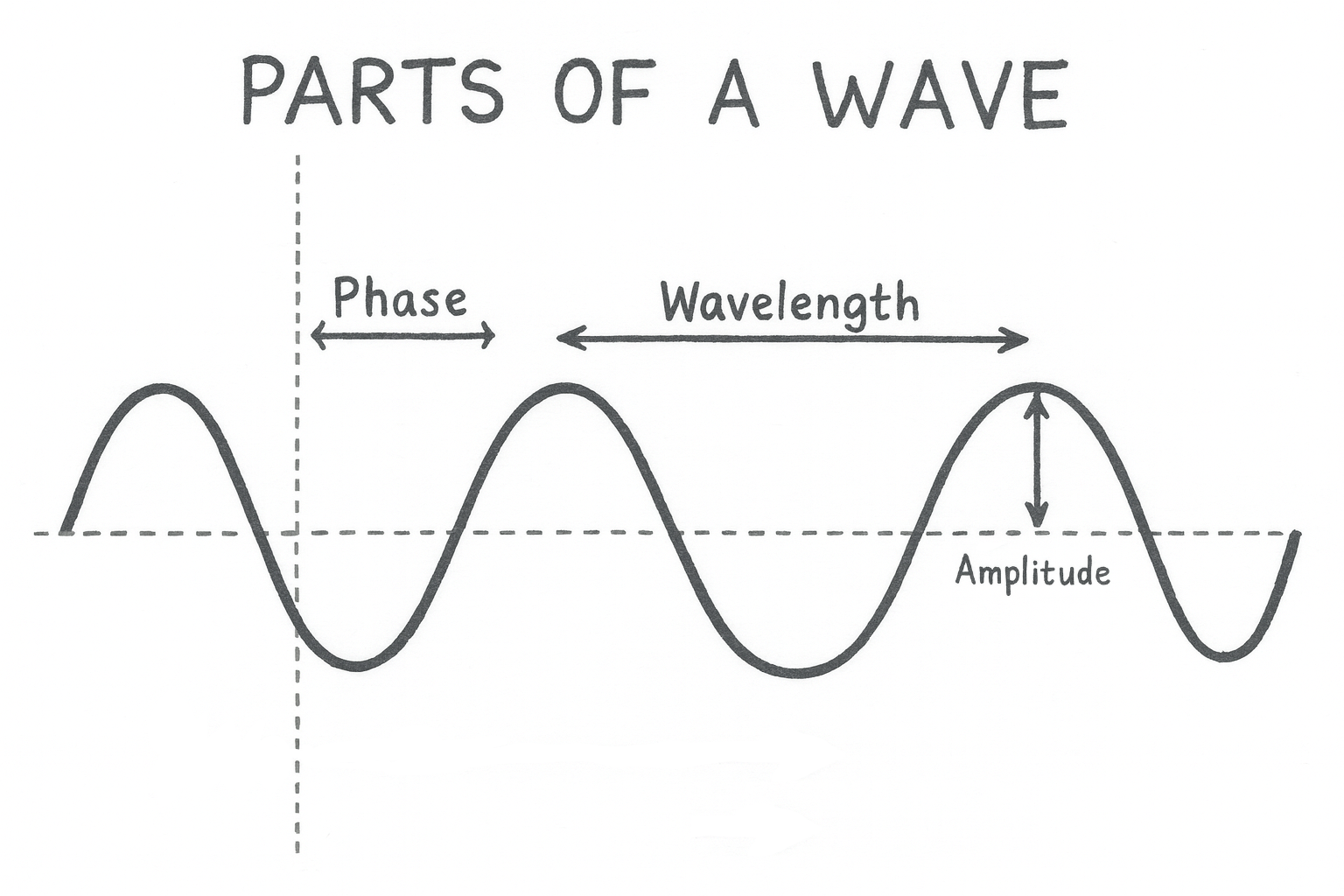
Frequency tells you what’s present. Amplitude tells you how strong it is. Phase tells you whether things are aligned—whether one signal arrives ahead of another, whether processes reinforce each other or cancel out.
Phase is orientation. Ahead or behind. In step or out of step.
That doesn’t sound like much. But orientation turns out to be a powerful kind of information. Because once systems have orientation, they can coordinate. They can interfere. They can stabilize or dissolve. Timing, direction, persistence—all of it follows from how parts line up.
This is why small misalignments don’t stay small. They cascade. They reshape what becomes possible next. And why moments of alignment—sometimes barely noticeable—can suddenly make action feel clear again.
Turning the language inward
Pribram used these insights to describe the brain’s language. My own work shares the same spirit—but applies it to a different object.
Where Pribram approached structure from the outside in—tracing how meaning is encoded and reconstructed in neural systems—I’ve been approaching it by mapping the psyche itself: the internal organization that makes thought, emotion, and agency possible at all.
The shift is subtle but important. The question is no longer just how the brain represents meaning, but whether the psyche and the brain might share a common formal language—one based less on symbols and content, and more on frequency, timing, and alignment.
If neural activity organizes around phase relationships, and if changes in psychological organization reliably move with changes in neural organization, then the psyche cannot plausibly be arbitrary or opaque. Whatever its ultimate nature, it must be structured in a way that is at least compatible with that language—not identical to the brain, not reducible to it, but lawfully correlated.
This opens a new possibility.
Not that we can “read thoughts” from brain activity, but that we might be able to recognize their structure.
In linguistic terms, this is the difference between semantics and syntax. Semantics concerns meaning: what a thought is about. Syntax concerns structure: how elements are organized so that meaning can arise at all.
This isn’t a definition of meaning in its richest human forms, but of the minimal structure that allows anything to matter in the first place.
The claim here is modest, but consequential: even if we never access the semantics of thought directly, learning the syntax may be enough to understand coherence and fragmentation—the ways psychological organization stabilizes, breaks down, and sometimes reorganizes.
This is where ontological mathematics enters the picture—not as formal calculation, but as a way of describing structure itself. Relation before symbol. Constraint before story.
If the psyche has lawful dynamics, then it can be studied as structure—not just narrated as experience.
What holds together
This is also where the word soul re-enters the conversation—carefully.
By soul, I don’t mean a substance, a belief, or a ghost in the machine. I mean the persistent, organized pattern through which agency, meaning, and choice are able to hold together over time. Not a thing you have, but an organization you inhabit.
At this point, the inquiry shifts in kind.
When the question turns to the soul, the work is no longer primarily empirical or interpretive. It becomes a matter of reasoning—asking what constraints must exist for thought, meaning, and agency to be possible at all. Rather than cataloging experiences, the method reasons from necessity: if minds can cohere, fragment, choose, and reorganize, then there must be an underlying structure capable of supporting those dynamics.
Whether one ultimately understands that structure in material terms, idealist terms, or something in between, the structural question remains the same: what allows a system to cohere strongly enough for intention, recognition, and choice to occur at all?
In Pribram’s terms, it’s closer to what he called the form within—a structure that persists not by remaining static, but by continually reestablishing its own coherence. What matters here is not the metaphysical label we give that structure, but the fact that it has shape, limits, and dynamics that can be observed.
And by quantified, I don’t mean reduced. I mean legible.
When coherence shifts, experience shifts. And neural phase relationships shift with it—together. Not as mirror images, and not as proof of identity, but as expressions of a shared underlying organization, one that remains meaningful whether you begin from brain, psyche, or something deeper still.
Listening for alignment
Seen this way, embodiment becomes easier to understand—and less mysterious.
Your body is not just matter obeying forces. It is a phase-locked system—one that maintains itself by continually synchronizing its internal rhythms with biological, social, and environmental ones. In that sense, walking is the coordination of coupled cycles. Balance is the continuous correction of small timing errors. Fatigue reflects growing phase drift as correction becomes costly. Flow is what happens when alignment deepens and resistance drops.
But the same logic applies more centrally to the psyche.
Alignment doesn’t simply mean “working well.” In healthy systems, components coordinate strongly enough to function together while remaining flexible enough to change. Too little alignment and the system fragments. Too much, and it becomes brittle—locked into a local order that resists development.
What matters, then, is not alignment in isolation, but alignment across scales.
A psyche needs its internal organizations to cohere without freezing growth or foreclosing possibility. Breakdown, from this perspective, doesn’t look like moral failure or weakness. It looks like a loss of viable coordination—either because parts fall out of sync, or because they lock together so tightly that the system can no longer respond.
Here’s where meaning enters—not in the semantic sense of what thoughts are about, but in a more basic structural sense.
Any system that maintains itself over time has to remain sensitive to what supports its continued coordination and what disrupts it. Some patterns stabilize the system; others introduce strain or interference. Over time, those differences begin to matter.
Once that happens, the system is no longer neutral to what comes next. It has a direction of activity. It has something at stake in how it responds.
Meaning, then, isn’t something added on top of experience. It’s what adaptive organization enables.
Once there is before and after, alignment and opposition, effort and resistance, there is already choice. Meaning doesn’t arrive later to explain these things. It arises from the structure that makes coordinated action—and continued development—possible in the first place.
A structural definition of meaning
Meaning arises when a system is organized enough that what happens next is no longer neutral to it—when some possibilities preserve coherence and others threaten it.
Stories, values, and purposes are how meaning appears to us, but they only work because something already matters at a structural level.
From Mythological Psychology to Structural Dynamics
This only establishes the ground. There’s much more to explore: how phase relates to time itself; how identity emerges as a stable pattern; how suffering reflects internal conflict between incompatible organizations; how cultures fragment when coherence breaks.
One place this becomes especially interesting is in how we revisit earlier psychological frameworks.
Thinkers like Carl Jung were already describing recurring patterns of fragmentation, compensation, and reorganization in the psyche—but they did so using the mythological and symbolic language available to them at the time. Archetypes, complexes, and the shadow were not meant as literal entities so much as ways of pointing to structural regularities in inner life.
What becomes possible now is to reread that tradition through a different lens: not as mythology, but as an early attempt to describe the dynamics of a complex system from the inside.
The Quantified Soul takes up this task directly. It asks what happens when depth psychology is reframed in the language of mathematics, systems theory, and dynamical organization—when archetypes become attractor states, complexes become stable interference patterns, and breakdown is understood not as moral failure, but as structural overload or loss of coordination.
This doesn’t “demystify” the psyche. It makes it legible.
And perhaps that’s the deeper shift underway. Maybe meaning never vanished. Maybe we’ve just been listening for content, when the deeper signal was structural all along. Not to explain the soul away—but to finally understand how it holds together, how it comes apart, and how it sometimes finds its way back into form.
If this way of thinking resonates, you’re already part of the inquiry.


Comments ()