Heavily Meditated or Heavily Educated? Why Feeling Better Isn’t Enough
Meditation can calm the mind—but clarity is the real prize. From biohacking to brainwaves, this is a look at what happens when feeling better isn’t enough.
This is a revised essay, as I practice my writing and finding my voice! Here I’ve attempted to avoid the deeper mathematical nuances that I find fascinating, but aren’t necessary to understand the benefits of becoming clearer, more coherent thinkers.
About a decade ago, when my thoughts began to slow and the world felt half a second behind, I found Dave Asprey. He was one of the first to insist that decline isn’t destiny—that you can measure, experiment, and hack your biology. That word, biohacking, reshaped everything. It reframed the body and brain not as sealed mysteries but as open systems, responsive to feedback, data, and intent. If you could read the signal, you could change the code.
Note to reader: Biohacking, as Asprey first framed it, simply means applying the mindset of an engineer to the human system—using data, feedback, and experimentation to improve energy, focus, and longevity. In short: upgrade your biology.
What began as a quest to optimize performance slowly revealed something larger: that the brain isn’t just a machine—it’s the interface through which mind itself becomes visible.
It was a thrilling idea: biology as software, and consciousness as something editable. And it arrived at exactly the right moment, when I was starting to suspect that my mind wasn’t firing on all cylinders. Asprey’s work became a bridge—a path out of resignation and into curiosity. He showed that you could bring the scientific method into the interior life: use measurement not as a cold instrument but as a form of self-discovery.
It felt like opening a hidden control panel inside myself—the same curiosity that drives engineers to build machines, redirected toward the invisible circuits of thought and feeling.
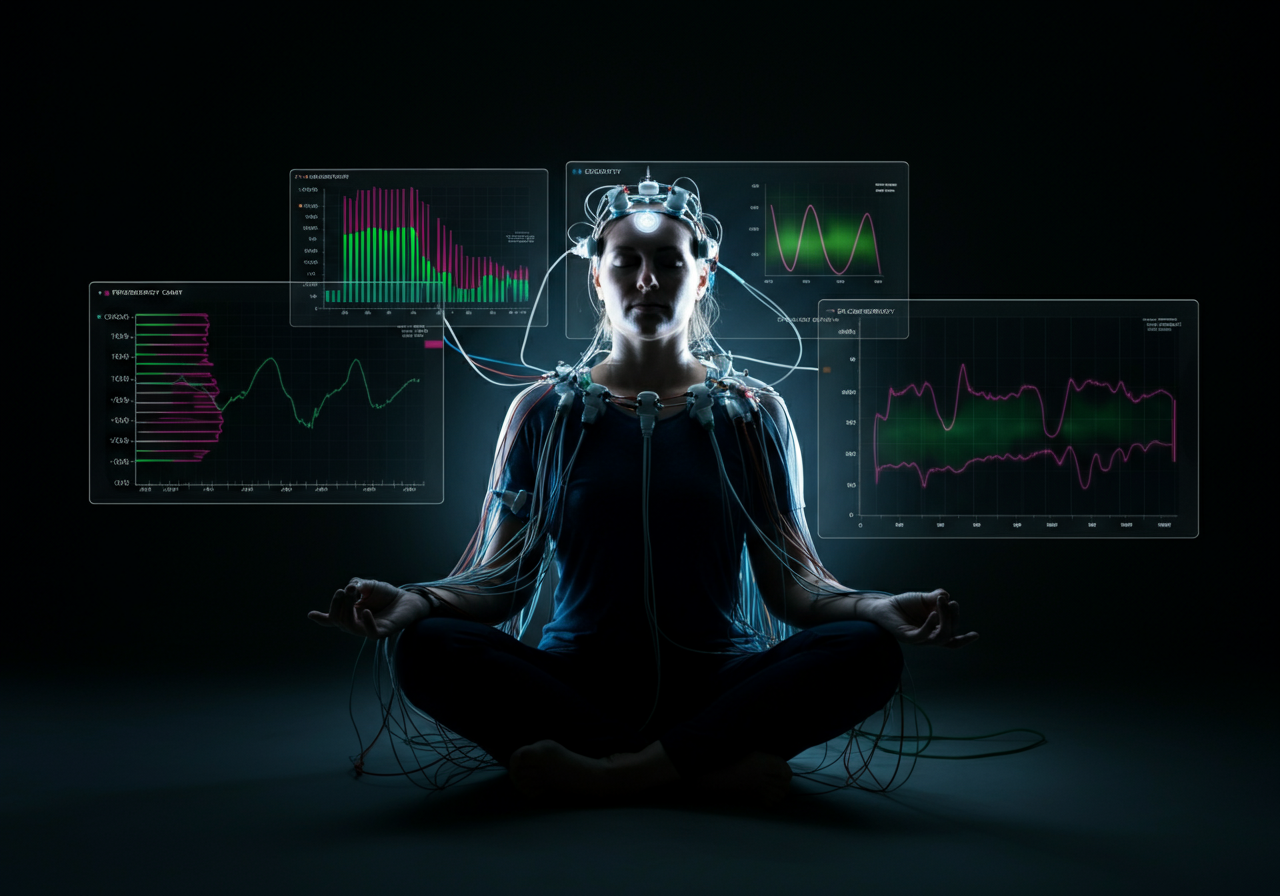
That mindset changed my trajectory. I began training in QEEG brain mapping and neurofeedback—quantitative electroencephalography, a way of recording and analyzing the brain’s electrical activity across multiple regions to identify patterns of imbalance—while studying functional nutrition and learning to read the brain’s rhythms the way a musician learns to read sound. And the deeper I went, the more familiar it all felt.
Note to reader: neurofeedback works much the same way. By showing the brain its own electrical patterns in real time, it lets the nervous system learn new rhythms—like holding up a mirror until balance returns.)
Somewhere inside the data and the graphs, I could hear older voices whispering—Tibetan Dzogchen on balance and awareness, Ayurveda mapping elemental patterns of mind and body, and Hermetic traditions speaking of harmony and correspondence. Science and spirituality, it seemed, weren’t opposites at all. They were describing the same structure from different sides of a mirror.
Please note that this content is free, and only requires a free subscription to view.