How We’re Reading It Wrong
In part one, I read Disclosure Day as a myth about a divided mind and the structure underneath reality. This piece turns around to face us. Because the film predicted its own reception—the way half the audience would count its flaws and the other half would feel something move underneath. The split in the theater is the split the movie is about. And it points at something we keep doing, with this film and with everything: looking for the answer in the one place it isn’t.
Here’s the part that genuinely unsettles me. The film didn’t just dramatize a divided mind. It divided its own audience along the exact same line.
The reviewers counting plot holes and grading the CGI. That’s the Emissary, filing bug reports. The part that takes things apart, doing its job perfectly, on a thing that can only be understood whole. Trees, no forest, and certain there’s no forest because it has counted the trees so carefully. The film is about a divided mind, and the audience split right down the divide the film is about. McGilchrist’s thesis didn’t get described by the movie. It got demonstrated by the people walking out of it.
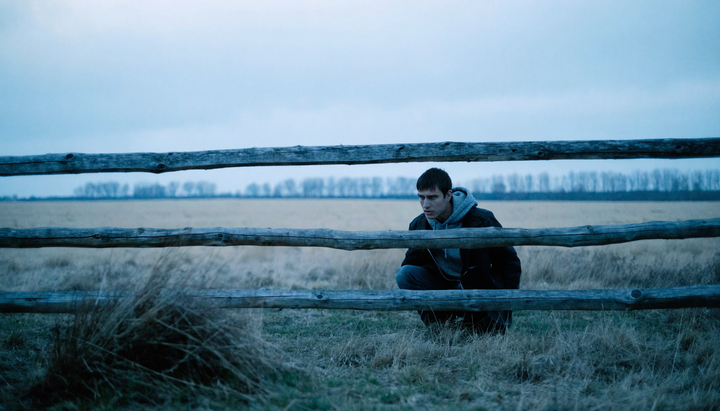
Take the scene everyone’s clowning: the one where the young man, crouched and creeping, “hides” behind a slatted wooden fence you can see straight through. The reviewers are right. It’s silly. As concealment it conceals nothing.
And here’s where I get a little strange about this movie. I can’t help wondering whether Spielberg left that in on purpose. Because a fence that hides nothing is also a picture of something true: the biggest secrets tend to be kept right out in the open. Not locked away—displayed, in plain sight, behind something transparent, protected by nothing but the fact that nobody bothers to look. The man crouches behind slats anyone could see through, and somehow he stays “hidden,” because no one is looking. That’s not a plot hole. That’s the whole thesis in one shot.
Maybe that’s generous. Maybe it’s a lapse and I’m reading intention into an editing-room shrug. But I find I don’t need to settle it—and there’s a real respect underneath the not-needing. Respect for an artist secure enough to leave the surface rough because he has full conviction in what’s beneath it, and genuinely doesn’t care whether you found the fence convincing. That’s not sloppiness. It’s a maker who knows where his care went, and where it didn’t.
But that’s just the loud version. The quieter one runs through all of us, and it’s the one that matters.
When something real reaches us, a signal or a shift, the sense that the ground is moving, the most natural move a mind can make is to put the source somewhere out there. The signal is real, so it must be coming from elsewhere. The readiness is real, so it must be a gift switched on from outside. The shock is real, so someone out there must be timing it, shepherding us, deciding when we’re ready. The instinct is right. The direction is the problem.
The film even hovers on that exact seam. Koepp, asked where the woman’s sudden fluency comes from, says it was given to her somehow, from deep within or far without, and can’t quite say which. That ambiguity is the whole thing. Offered “deep within” or “far without,” we reach, almost every time, for far without. It’s not a failing of any one group. It’s how a mind that leads with the wrong half tends to work. It locates meaning anywhere except the seat of the one doing the looking.
And the cost of that move is the same cost the film keeps pointing at. The gap between where we’re standing and where the thing actually is comes down to one habit: we put the wisdom, the authority, the rescue, outside the circle. The correction is to put the observer back inside it. Any framework that exempts someone—the cosmic parents, the watchers, the ones who supposedly know—from the constraints it places on everyone else is incoherent on its own terms. That was the villain’s move with the device. It’s the same move, dressed as benevolence. The Quantified Soul makes that the one rule it will not bend: the structure includes the observer, and the moment you exempt yourself, understanding curdles into authority.
The Shock We’re Avoiding
Spielberg gave the thing its name, in that conversation with Tyson. Ontological shock. What happens, he says, when your fundamental beliefs about what reality is get shattered by a new reality. He thinks full disclosure would deliver exactly that, and that this is why it stays quiet—not malice, just a civilization that has never handled sudden change well, and isn’t handling it well now.
He’s right that the shock would be real. Here’s what I’d add: We are already inside something that should be shattering our model of reality. And we’ve gone numb to it instead.
Look at the world the film uses as its backdrop. Spielberg put it there on purpose; he told Tyson he wanted the sense of something approaching critical mass, brought the word defcon back, set the story against the actual hot spots in the actual news. Some serious people will tell you we are, technically, already in the early movements of a third world war, and that the climate is doing things the models were built to rule out. And the response to all of it, broadly, is a shrug. The price of eggs. There’s a whole genre of very rich men explaining that this is the brightest moment in human history and that you’re foolish or hysterical to feel otherwise.
That numbness is the pathology. Not the coming shock, the shock we’re already declining to feel.
And the film makes a quiet choice, buried in a plot turn. The aliens, the supposedly superior intelligence, turn out to be woundable. Their ships crash. They bleed. Koepp, the screenwriter, talks about this as a deliberate subversion—the assumption that aliens are omnipotent, invulnerable, gods, and the move to break it. They’re not gods. He’s making a point about craft, about why a vulnerable alien earns something from us that an all-powerful one can’t.
But I can’t help reading it against the moment we’re in. Because there’s a worldview loose in the culture right now, one that sells, that tops the lists, and it says technological power is making gods of us, that exponential capability is the same thing as ascension. The film, whether it meant to or not, disagrees. Power that crashes, that bleeds, that can be injured, is not divinity. It’s just power with better tools.
This is where coherence stops being a compliment, and I need to say the hard part of my own framework plainly, because it’s the part that separates it from the abundance gospel. Coherence is structural. It says nothing about whether a thing is good. A perfectly coherent system can be malignant—cancer is coherent, after all, ruthlessly so, every cell pulling in the same direction. So is a tyranny. So is a man who has organized his entire life around a single appetite and never once looked at it sideways.
More coherence is not more good. A civilization optimizing harder and harder, more capability and more abundance and more reach, with only half its mind engaged, the half that manipulates parts and never grasps the whole, is not ascending toward godhood. It’s a tumor with a vocabulary. This is the distinction The Quantified Soul keeps insisting on, and it’s the one the abundance gospel never makes: coherence is an arrangement, not a virtue, and more of it is not the same as better.
Spielberg said he wanted the end of the film to land like someone clapping their hands in front of your face. Wake up. That’s the disclosure I actually care about, and it isn’t information arriving from a ship. It’s the part of us that grasps the whole, waking up inside a civilization that has been running on the part that only grasps pieces.
Nobody’s Hiding It
Here’s the demand under the whole disclosure conversation: they’re lying to us, and we have a right to the truth. The feeling is legitimate. People have been condescended to, and the appetite for straight answers is honest. But I think the thing being asked for is stranger than the people asking realize, and it changes what “being lied to” even means.
A cover-up assumes the secret is a fact. A body in a hangar, a craft, a file with a classification stamp, something that could be handed over in an afternoon if someone decided to. And if the secret here were really the nature of reality, how mind and math and matter actually fit together, then it was never that kind of thing. You can’t leak an understanding. There’s no document. A fact you can disclose; an understanding you have to build, in yourself, by work. Demand that it be released and you’ve made a category error: you’re treating wisdom like intelligence, the kind of thing that sits in a safe.
Which reframes why so much of this knowledge has always looked like a secret. Not, mostly, because someone was hoarding it to keep you down. That happened, and where it hardened into a priesthood guarding the gate, it deserves every bit of the suspicion it gets. But the deeper reason is duller and more humane. Certain knowledge is destabilizing to a mind that hasn’t built the structure to hold it. Hand someone the conclusion without the scaffolding they’d have constructed getting there, and you don’t enlighten them—you fragment them. The old traditions gated their material in stages not only out of arrogance but because, taken out of order, it breaks people. The veil was often a load limit, not a velvet rope.
And the gating was never moral. It is not that some of us are worthy and the rest aren’t. It’s that the understanding requires a kind of coherence to carry, and that coherence is built, not granted—the same as anything hard. Nobody’s gifted it. Anyone can do the work. Almost nobody does, because it’s genuinely difficult and there’s no shortcut that doesn’t just leave you holding a slogan. The door isn’t locked. It’s heavy. Those are different problems.
So the truth we keep demanding be disclosed was never a fact to leak. It’s an understanding to build—which is exactly why, in every era, it has worn the face of a secret. It was hidden the way the meaning of a hard book is hidden from someone who hasn’t read it yet.
None of which means there’s nothing out there. Maybe there is. Maybe contact is real and close, and one day the fact does get handed over. The point is order of operations. Even if the ships are real, the thing that would let us meet them as anything other than frightened animals is the same thing the traditions were always pointing at—knowing what we are, clearly enough to hold steady. The understanding comes first. It has to. The fact, if it ever lands, lands on whatever we’ve already built to receive it.
That’s the stance The Quantified Soul takes, against the priesthood and the cover-up both: no intermediaries, no permissions, the structure laid out to be tested by anyone willing to think carefully enough. Not a leak of the answer. An attempt to build the scaffolding, so the thing can be earned instead of merely believed. That’s the only honest form disclosure could take. Nobody’s hiding it. Almost nobody’s looking.

Comments ()