The Master's Real Language
A long read, about 25 minutes. If these ideas are your thing, it's worth the time, and you can take it in pieces. The essay opens with the civilizational challenge Iain McGilchrist lays out, the divided brain and the cost of letting the left take over, then walks through my own unusual wiring, which turns out to matter for the lateralization story. From there it turns to mathematics, not as procedure but as a language, one with the power to unpack structure, even the structure of your own mind. And it lands on a claim: that learning to read and practice mathematics this way may be how we recover the balance between the hemispheres we've lost.
Have you ever known something was true and not been able to say why?
Not a hunch. Known it—the way you know a face. And then watched yourself fumble for words that somehow flattened the very thing you were trying to point at, until you gave up and let it go untold.
That experience, I've come to think, is one of the most fascinating nuances about how minds work.
Iain McGilchrist explains it better than anyone. Two enormous books—The Master and His Emissary and The Matter With Things—and they read, to me, like one long argument that grows louder the further you go. The first lays it out: two hemispheres, two ways of attending to the world. The right takes in the whole. The left dissects, names, manipulates. They are supposed to work together, with the right in charge and the left in service. By the second book, that polite distinction has become a civilizational diagnosis. We have inverted the relationship. The servant runs the household. And the world we've built—flat, anxious, drained of meaning—is what that inversion looks like from the inside.
It's a hell of a case. I find it persuasive almost every time I sit with it.
And there's one detail in his portrait of the right hemisphere—the Master—that I cannot leave alone.
The Master is nearly mute.
The part of us that grasps the whole, that holds context, that perceives the living shape of a thing before it gets carved into parts—that part can't really talk. Speech lives on the other side. Whatever the Master sees has to be handed off to the Emissary to be put into words, and the Emissary, by its nature, takes the round thing and lays it flat.
What School Couldn't Teach Me
I have spent a long time inside that dilemma. Not just as a reader.
When I was growing up, I could not see the parts. I mean that almost literally. The basics in elementary and middle school I could memorize my way through. But the moment school asked me to show how I got there—to walk the steps, not just produce the answer—something failed. The parts wouldn't stick. They felt arbitrary, disconnected from anything.
I got through math up to algebra by memorizing rather than learning. And when I did multiplication, it didn't feel like calculation at all. It felt almost spatial—like I was rotating things in some inner space to make them fit together, the way you might fit pieces in Tetris. I didn't know that wasn't how everyone did it.
What I could see was shapes.
Give me a whole, and I could move through it. Once I grasped the form of a thing—how it hung together, what it was really doing underneath—the parts arranged themselves and suddenly made sense. The whole came first. The parts fell into it.
This made me a good hacker, years later. I'd take a system I wanted to understand and turn it over in my head until its structure gave way. Not by reading line after line of code, but by feeling for the shape of the thing and letting the details resolve against it. I read the forest. The trees came after.
Most of the time I couldn't show my work. I didn't trace it; I felt for it. Which would have been a problem in any other field. In tech, it was a superpower. I could operate a system long before I could explain it—read its shape, predict where it would break, navigate by intuition while the people who'd built it were still drawing diagrams. The thing school had punished me for—not being able to walk through the steps—turned out to be the thing the work rewarded.
It was only when I started studying QEEG—putting electrodes on my own head and watching the readout—that I saw it wasn't a quirk at all.
Seeing It on the Instrument
There is a measurable asymmetry in my brain. In the left fronto-temporal region, the slow rhythms run almost two cycles per second behind their counterparts on the right. It's not a lesion. It's not damage. It's subtler than that—a standing difference in resting rhythm, the left tuned lower than the right. And I have come to think it's exactly what lets the right take the lead in most of what I do.
And I have a particular reason to think it's not damage. The pattern shifts. When I do certain kinds of inner work—dialogue with the part of me that lives on that quieter side, the active-imagination work people in some therapeutic traditions know well—I can watch the readings change. A lesion doesn't do that. A configuration does.
The side that comprehends runs the show. The side that names and sequences—that apprehends—lags behind, present but not in charge. The dissociation is real enough, and the foreignness of that quieter left side has been pronounced enough across my life, that I eventually gave it its own name. That's a longer story for another time.
I tell you this not as confession and not as credential.
Honestly, I don't know my own architecture for certain. What I have is subjective experience, which can deceive, and patterns in my own readings that seem plausible to me. Brains are stranger than the tools we currently read them with. The configuration I'm describing is the best account I have. It almost certainly isn't the whole story.
And the configuration isn't a free win. The right-bias makes left-brain thinking take real effort for me—the careful, sequential, line-after-line work doesn't come easy. I lean hard on tools, and not as a stylistic choice. The linear assembly of an argument across many pages is genuinely effortful for me. The book this essay belongs to was written with LLMs doing the sequential scaffolding while I supplied the structure—the whole, the shape, the wager. The collaboration is what made the work possible at the length it needed to reach. Without that prosthesis the comprehension would be intact and the rendering would never have caught up.
It may be why this problem felt familiar from the inside, rather than something I only encountered in books. And why McGilchrist's diagnosis kept pressing on me.
If the Master is mute—mute in what?
The Wrong Demand
We say the right hemisphere can't speak.
What we actually mean is that it can't easily produce words.
Notice the assumption buried in that. We've decided that to speak is to do what the left hemisphere does—lay meaning out in a line, one symbol after another, the way arguments and sentences proceed. By that standard, of course the Master is mute. We're asking it to perform in a medium that belongs to someone else.
But muteness in one language is not muteness. It's the wrong demand.
McGilchrist describes the right hemisphere as the one that grasps wholes—context, relation, the living shape of a thing. I want to take one step further than he does. What actually underlies that grasp, what makes it possible at all, is the comprehension of structure.
To perceive something wholly is not to receive a single, undifferentiated impression of it. It's to see how it's put together. A face you recognize whole is not a blur. It's a configuration—proportions and relations held all at once. A system you read intuitively isn't formless. It's its shape, grasped before its parts. Structure isn't imposed on the whole after the fact. Structure is what makes a whole a whole, instead of a fog.
And not linear structure. Linear is the Emissary's domain—A leads to B, one thing after another, the chain. The Master's structure is configurational. All parts in relation at the same time. Present together.
Think about how you hear music. Not note by note, totting up a sum. You hold the architecture of the piece while it's playing—the whole shape, the way the parts are calling to each other, the arc you can feel ahead of the next bar. The notes are linear. The understanding isn't. That is structure perceived whole. Every culture that has ever made music has been training the Master in plain sight.
That distinction matters, because the implicit—McGilchrist's preferred word for what the right hemisphere knows—doesn't have a language. Structure does.
What the Angle Showed Me
I should tell you how I came to this. I didn't reason my way to it. I encountered it, and the encounter was the kind of thing that makes you trust a direction before you can defend it.
In my thirties I started doing neurofeedback work—first to perform better at a demanding job, then, as old questions resurfaced, to follow them honestly. Some of the work reached into very slow rhythms, the deep bass notes of the brain. I would rotate attention across regions, watch how each part of the system was thinking, and trace thoughts back toward wherever they came from.
I couldn't help noticing that my thoughts were coming from an angle.
Not from nowhere. Not from emptiness. From a direction. By angle I don't mean a visual image or a place in space. I mean a consistent directional constraint—a sense that thought emerged with asymmetry, with a shape it had to take, before any content had arrived to fill it.
I trusted the angle and followed it. What I had run into wasn't mystical and it wasn't emotional. It was structural. Thought itself had a shape—not after the fact, but before. A geometry. Constraint, not arbitrariness.
And once I noticed it, I realized I had been doing this my whole life. People, concepts, systems, arguments—everything had arrived to me with a kind of contour. Not visual. Not anything I could draw. A felt sense of how the parts held together, where the tensions sat, how one piece fit against another. I called it a shape, for lack of a better word, and never questioned it.
I had been comprehending structure for as long as I could remember—holding it whole. What I couldn't do was render it: take the thing I was holding and lay it out in a line someone else could follow.
It's not that the left side doesn't work for me. It's that it works through a kind of fog. The thinking happens, but unevenly.
Reading is the strangest example, and I have a hard time describing it cleanly. I'll joke that reading the words slows me down, and I'm serious—but I still look at the pages. My eyes are on the words. They're just kind of glossy in that experience. They're there, they have a surface, but I'm not going through them one at a time the way I think other people do. The shape of the passage often arrives before the words, or somehow with them, ahead of them. By the time the sentences are in any sequential order, I've already understood. The reading, after that, feels more like waiting for the language to confirm what I'm already holding.
Words work the same way. They arrive to me with a kind of geometry. They have shapes, and the shapes relate to other words' shapes, in ways that don't always track the conventional meaning. I'll tell my partner that love is a vicious cycle when done right—and mean it in the best possible way, because the shape of "vicious cycle" feels exactly right for what love-done-well actually does. Recursive, intensifying, each turn deepening the next. The dictionary valence of vicious is beside the point. The geometry is what I'm reaching for.
So I'm not really using words for their definitions. I'm using them for their shape, and selecting whichever word's shape best matches the shape of the thing I'm trying to name. Most of the time this lines up with what people expect. Sometimes it produces constructions where the shape fits and the meaning technically doesn't, and the person I'm talking to either lights up because they hear the shape too, or pauses because they're checking the dictionary. I can't fully verify any of this from the inside. But it tracks with everything else.
I can force myself to read linearly—page by page, one word at a time—and sometimes I have to, especially when the material is unfamiliar or the structure is precisely what I need to track. But it's effortful in a way that, I gather, it isn't for most people. The picture is usually already there. Reading the words is the long way around to it.
The rendering did come, just much later, and through two specific things. Reaching the left side of myself in dialogue, learning to hear the part of me that handles articulation as its own counterpart. And meeting the right material at the right time: Euler's formula, read structurally rather than procedurally. That was the moment the comprehension found something it could say. The mathematics didn't replace the seeing. It rendered it.
I didn't get there alone. Ontological mathematics—laid out across Mike Hockney's 32-volume God Series and extended in Thomas Stark's 18-volume Truth Series—gave me my first way to read my own inner experience: not as a quirk, but as something with a structure. I come to that work as a student, not a mathematician; an intuitive, neurodivergent thinker with one problem he's trying to solve. What I've been doing since is taking a small corner of it somewhere it hadn't yet been carried—into the brain, and the divided attention McGilchrist maps. The seeing was always mine. The language for it is theirs.
And once that happened, something else opened up. Reading mathematics this way wasn't just useful for explaining what I'd been perceiving. It started to deepen the perceiving. The more I held equations as structures rather than procedures, the more the seeing itself sharpened—as if the right side were learning, through the rendering, how to see more carefully what it had already been seeing. The channel runs both ways. Rendering the whole, in the right language, doesn't only carry the seeing across. It refines it.
There's something stranger about this I want to mention, because it bears on the claim I'm about to make. When I take something I've held whole and work it into words—draft it, sit with the draft, encounter it as a reader—I often find I'm seeing the idea for the first time. Not seeing it more clearly. Not having it confirmed. Seeing it. The whole I'd grasped before writing was real, but it wasn't yet fully visible to me until the writing came back and met it. The rendering didn't just translate the seeing. It was part of how the seeing happened. The two sides aren't sequential. They're constitutive of each other.
Which is part of why I think this matters beyond me.
The Tool the Master Lacked
The standard reading of mathematics goes like this. Mathematics is a system of operations. You have numbers and symbols. You have rules for manipulating them. You apply the rules step by step and get an answer. Calculation. Procedure. The most Emissary thing imaginable.
If that's all mathematics is, then it's the last place you'd look for the Master's voice.
But there's another way to hold it. McGilchrist half-grants it himself: number reads two ways, he says—as an absolute, the Emissary's count, or as a relation, how one thing stands to another, which he places in the right hemisphere. What's left is to take that relational reading literally, all the way to reality.
Not as a system of operations performed on quantities. As a description of how reality is actually put together. Read ontologically—as the account of what is, rather than a technique for calculating—mathematics stops being a procedure and becomes a portrait. The equation is not an instruction. It's a shape.
Let me try to make this concrete, because the claim is doing too much work on faith.
Consider Euler's formula. You may have seen its most famous case—the one that sets the angle to π and collapses to e^(iπ) + 1 = 0—called the most beautiful equation in mathematics. The general formula behind it looks like nothing in particular until you sit with it:
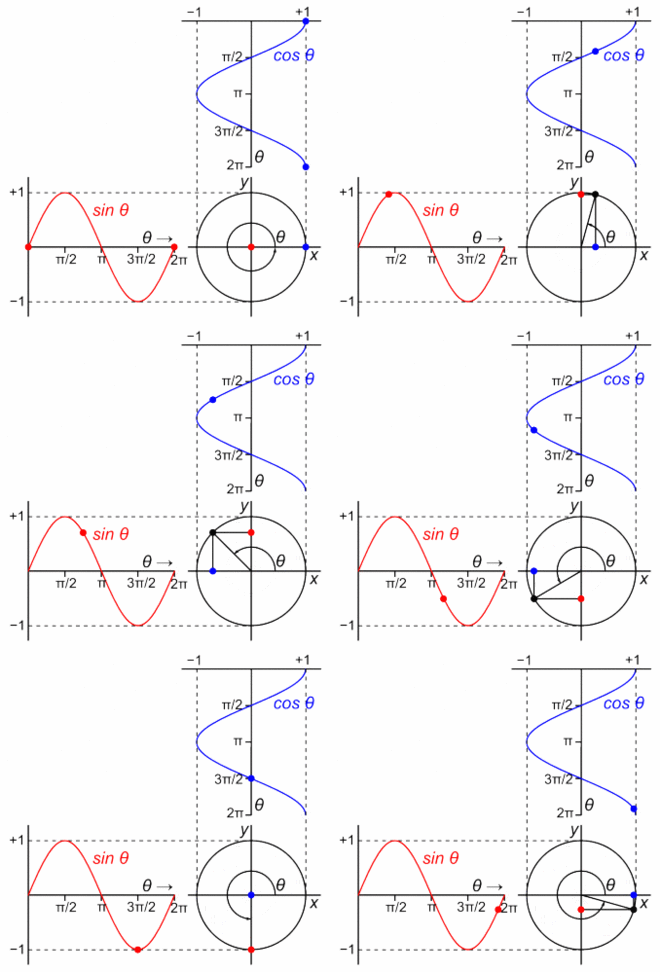
e^(iθ) = cos θ + i sin θ
The procedural reading goes like this. e is a special number, around 2.718. i is the square root of negative one, the imaginary unit. θ is an angle. Multiply i by θ, raise e to that power, and you'll get the same result as taking the cosine of the angle plus i times the sine. It's a true statement. You can verify it. You can use it to do calculations.
And read that way, it's not particularly moving. It's a fact you accept.
The Ontological Reading
Now hold it the other way.
Forget calculation. Look at what the formula is. On the left, an exponential—the function that describes anything growing or oscillating freely. On the right, a circle—the rotation of a point around an origin, broken into its horizontal and vertical parts.
Here's the strange thing the formula is saying. The exponential function—the one we associate with growth, with things stretching outward—does something completely different when you give it an imaginary number to grow along. Instead of extending outward in a line, it curves. The growth, with no real axis to extend on, has nowhere to go but sideways. Sideways, in the complex plane, means around. Exponential growth in imaginary time is rotation.
Two operations that look unrelated turn out to be one operation, seen from different sides.
And once you see that, the formula stops being a statement and becomes something else. Not a picture, exactly—pictures are spatial, and there is nothing spatial here. What you're holding is an immaterial structure. A relation. An exponential and a rotation revealed as the same thing. A real part and an imaginary part held forever in right-angle relation, one tracing cosine while the other traces sine, ninety degrees apart, in lockstep. Nothing moves. The relation just is, every part of it present at once.
Our minds reach for the spatial image because it's the closest handle we have. We see a point traveling around a circle, real component up, imaginary component sideways, the wave-shape projecting onto the axes as it goes. That picture is real and useful. But it's the scaffolding, not the structure. The structure is what makes the picture cohere. The structure is what the picture is of.
You don't compute it. You don't quite watch it. You hold it whole.
So far this is only a claim about an equation: that it can be read as a structure instead of a recipe. On its own that's a nice shift of perspective and not much more. It turns into something larger only if the structure is real. Not a pattern in our symbols, but a pattern in what is. That takes some showing, and it comes in two moves: first what the equation says about a mind, then what it says about the world. The first is the stranger of the two.
Start with what's actually in front of you. Look at how it sits. Every point on the circle is answered by its opposite, real against imaginary, positive against negative, each thing matched by its equal and contrary. Add the whole of it together and it comes to nothing. The circle rests on zero, no part outweighing another. And yet it never stops. A motion with no mover, cosine and sine turning through each other forever, ninety degrees apart, neither one ever catching the other. Nothing sets it going. Nothing keeps it going. It simply is, the way a truth is: necessary, timeless, complete in a way nothing inside time ever manages to be. It sums to nothing, and it is never, for an instant, still.
Sit with that and a stranger thought arrives. This is what a mind looks like at the root. Not a brain. A mind, the bare fact of one: an indivisible point that is nothing but its own eternal, self-relating motion. It's the oldest intuition in the line I work from. Pythagoras heard it as proportion. Leibniz named the unit the monad. In our own time, Mike Hockney and Thomas Stark built it into a full system. The through-line is that the soul is at bottom a mathematical motion, and Euler's formula is its barest sketch: the necessary, eternal turning of a mind around itself. I'll use the word soul, and I mean it structurally, not devotionally.
I'm not going to earn that here. The road from a rotating point to the motion of a soul has far more steps than one essay can carry, and walking them is most of a book, the one this essay belongs to. For now I only want the direction visible: the structure you just held whole isn't an abstraction floating over the world. It's the form of the thing doing the holding.
And here is what keeps it from being a pretty idea about minds and nothing more. The same structure turns out to be what the world outside the mind is made of, too.
McGilchrist himself, in The Matter With Things, argues that the deepest mistake of the modern West is treating reality as a world of things—stable, separable objects we can pick up and manipulate—when reality is in fact a world of process and flow. Matter, on his telling, is not a collection of substances but a set of relations, patterns, transformations. The Emissary's instinct is to freeze the flow into things; the Master sees the flow.
I agree with him. And I would press the case one step further than he does.
If reality is process rather than thing, then we have to ask what processes are made of. They are made of cycling. Things that turn, oscillate, repeat, propagate, fall and rise. Light cycles. Electrons cycle. Sound is air cycling. A brain runs on a vast layered architecture of cyclings—theta, alpha, beta, gamma—nested in and out of phase with each other. The world, at every scale we can measure, turns out to be made of waves.
And waves, as we've just seen, have a particular structure. Each one is a cycling, and what makes a cycling distinct from any other isn't its substance but its phase—where it is in its cycle, and how its angle relates to the angles of the others around it. Phase is just angle—where a cycling sits in its turn. Which is the word I'd reached for, long before I had the math to hold it, when I said my thoughts came from one. Stack the phase relationships and you get patterns. Stack enough patterns and you get everything that has a shape. The mathematics here—Fourier, holography, the wave equations that run through physics—isn't a map laid over the territory. It is what the territory is made of, when you stop looking for objects and look at relations.
Which is the metaphysical move, and I'll name it as one. The Pythagorean intuition, refined by Leibniz, has always been that reality is structurally mathematical—not that mathematics describes reality from the outside, but that the structure mathematics speaks of is, at root, what reality is. I read McGilchrist as pointing in this direction without always making the move explicit. His argument that matter is process, that what we see are patterns rather than things, that the right hemisphere reads relation directly while the left freezes it into representable objects—to my mind these claims lead toward a Pythagorean position, whether or not he would put it in those terms.
What I want to add is the specific claim that structure—the structure he and I both think is real and prior—has a language. The language is mathematical, ontologically read. The reason waves can be described by Euler's formula is the same reason brains can grasp faces whole: both are participating in the same kind of structure, the structure of phase relations among cyclings. The mathematics doesn't impose form on the world. It reads form with the world.
This is why I think mathematics, held ontologically, is the Master's language. Not because math is beautiful, or elegant, or universal—those are aesthetic claims. Because the thing math is about, when you stop computing and start seeing, is the same thing the right hemisphere has been reading all along. Structure-as-configuration. Wholes built of relation. The room that opens up when you stop walking single file.
The equation was only the door.
Mathematicians themselves know this, even if they don't say it in these terms. There's a difference between following a proof—stepping through the chain one line at a time—and seeing a proof. Seeing it whole. Holding the entire logical shape in mind, all of it present, knowing why it had to be true before you've reread a single line. Every working mathematician has had the experience. The proof on the page is linear. The understanding of why it works is configurational, instantaneous, all-at-once. It's happening, quietly, inside the very discipline I'm pointing at.
And this is, I think, where the hemispheric story comes back into focus.
What I've just walked through is what McGilchrist points at when he describes the right hemisphere's mode of attention. The grasp of the whole. The configuration held all at once. The whole before the parts. He has spent two books arguing, persuasively, that this mode of attention has been displaced—that the left hemisphere's piecemeal, abstracting, manipulating habits have taken over the household. And mathematics looks, at first, like that displacement made into a method: the Emissary's signature move, lifting the form out of the living thing, manipulating the symbols, mistaking the manipulation for understanding. That worry is fair, and worth taking seriously.
But it lands on procedural mathematics, the absolute reading, the count and not the relation. Read ontologically—as the structure of a thing rather than a technique for calculating—mathematics may be the only language we have that doesn't break configuration into a line. It holds the whole as a whole, and it can hand that whole to someone else without flattening it first. Every other language points at structure from outside. This one is made of it. Which is to say, it is the kind of language the Master might actually be able to speak in, because it doesn't demand he stop being himself in order to speak it.
The muteness was never absolute. The Master was mute in the Emissary's tongue. Given a tongue of his own—a language structural enough to carry what he sees—the silence breaks.
Why the Master Went Quiet
If the Master had a language all along, a harder question waits.
Why did it fall silent in the first place? Why did we spend centuries treating the analytic, sequential, left-hemisphere mode as the whole of serious thought?
I've come to think the silence was necessary.
Not a fall. Not a mistake. A stage.
Look at what the analytic turn actually did. Before it, thought ran on resemblance and influence. Naming a thing gave you power over it. Like affected like. The world was thick with hidden correspondences and invisible causes. Magical thinking, in the literal sense.
What pulled us out of that was the insistence on the testable. Show me. Measure it. No causes hiding in the gaps.
That insistence is the Emissary's gift. It's materialism, and it was indispensable. You don't get rigor without it. You don't get a floor under your feet without first refusing every floor that won't hold weight.
What the Numbers Leave Out
The same thing shows up in my own work. The more I've studied QEEG and neurotherapy, the more I keep running into something the standard analysis can't hold. The measurements are real, and I trust them. But the familiar tools of the field, band power averaged across windows, ERP components averaged across trials, flatten the very thing they're meant to read. The arc of what a brain is actually doing, the configuration the right comprehends in one stroke, isn't in the numbers. The numbers are true. They're also not the whole shape.
So my work has become, more or less, the effort to show what I comprehend. To take the configuration I grasp in one motion and render it into something analytic, derivable, shareable. Not to step off the floor the discipline gives me, but to put more of what I see on it.
What's true for one mind may be true for the species. We made the same move, in the same order.
The Emissary's long ascendancy was a boot sequence. The left hemisphere took the wheel because we needed what only it could provide—the capacity to test, to derive, to build a chain of reasoning another person could check. That work had to happen. The Master, left to itself, sees truly. It can't prove. It can't share. It can't correct itself against another mind.
It needed the Emissary to grow up.
What it didn't need was for the Emissary to forget it was ever a servant.
The Turn We Are In
Which is where I think we actually are.
Not at the end of the analytic age. And not in flight from it. At the point where the boot sequence has done its work, and the next move is not more left, but the return the whole cycle was always for.
McGilchrist describes that cycle himself. Experience originates in the right, passes to the left to be analyzed and articulated, and returns to the right to be reintegrated into the living whole. What's broken is the return trip. The Emissary takes the insight, renders it flat and useful, and then mistakes that rendering for the whole of reality. The map becomes the territory. The Master—still seeing, still mute in the only language we credit—gets no say.
The repair is not to silence the left.
That would undo everything the boot sequence bought us. It would be its own kind of magical thinking—the fantasy that we can have the whole without the discipline.
The repair is integration. Let rigor stand exactly where it is. Stop pretending it's the only way of knowing. Recover the Master's primacy without losing a single thing the Emissary built.
We are not the first stage to need a new competence. And we know now that competences can be acquired. Learning a second language reshapes the mind that learns it—measurably, down to the structure of the brain. A child who picks up French alongside their first language starts seeing patterns in English they'd never noticed before. The grammar that was invisible becomes visible. The world hasn't changed. The mind has.
Think about what happens when you start treating mathematical relations as the description of how things actually are. You read them ontologically, not as calculation. You keep coming back to the structures that make everything possible.
Then you apply that view. To a conversation. To a system. To a body. To a city block. Each time, you're asking your mind to grasp the configuration whole—the relations all at once.
Do that for long enough, and the mind starts arriving at the structural view by default. Not because you've practiced calculation. Because you've practiced seeing.
I know it sounds backwards. Math is supposed to be the analytical mode. But ontological math asks the analytical channel to deliver, again and again, the very kind of whole the right hemisphere already knows how to hold. The channel trains what flows through it.
If a spoken language can reshape a mind, then learning to read the world mathematically, ontologically, structurally, may do something similar. Train the mind, over time, back toward the mode that grasps the whole. Not by abandoning sequential reasoning—we'd lose everything the boot sequence bought us—but by using it, again and again, to deliver the structures that teach the Master to speak in the open.
That's a belief, and I'll name it as one. But it's the kind that earns its keep by being testable in the living of it. And it's the wager my own work is built on.


Comments ()