The Mathematics of Talbot’s Holographic Universe
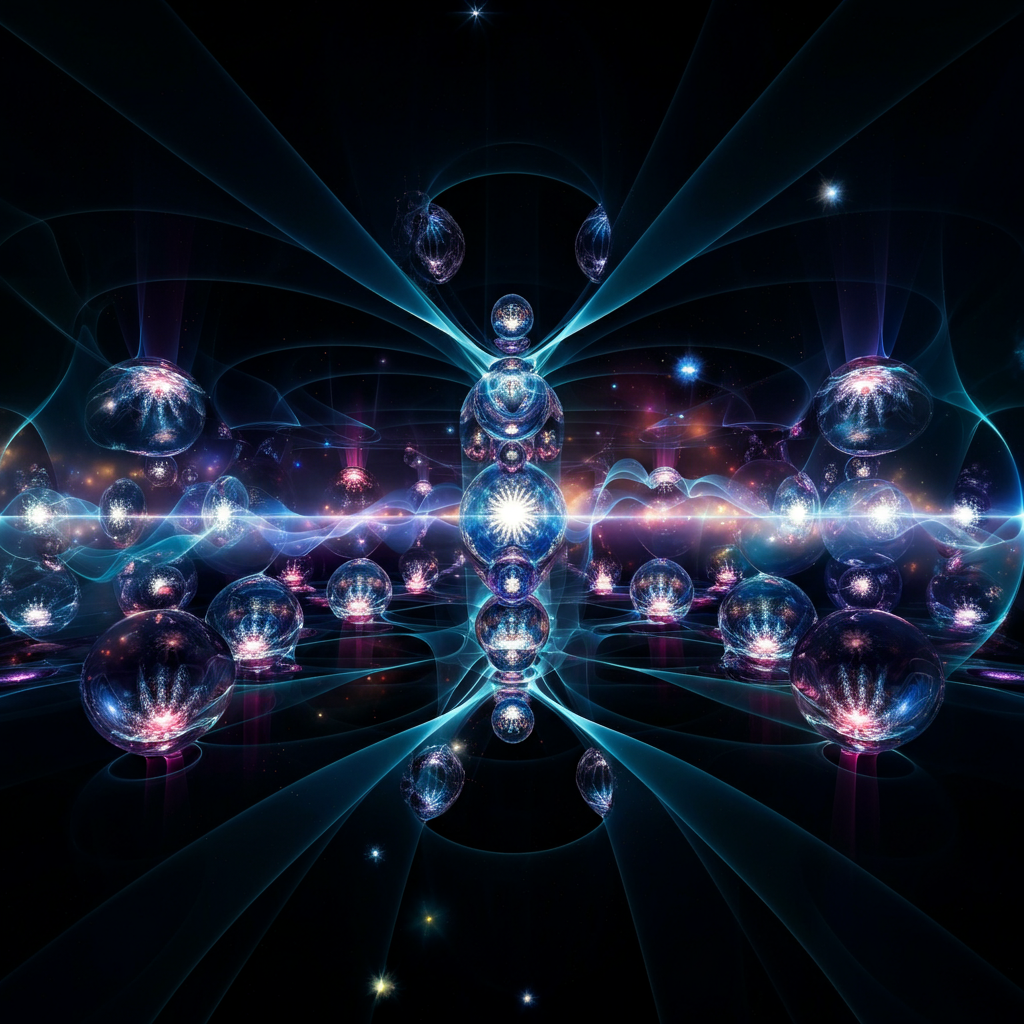
If you drop two stones in a still pond, the ripples don’t just pass each other neutrally. They meet. They interact. Where crest meets crest, the wave rises higher. Where crest meets trough, they cancel each other out. This is interference. It’s not an analogy. It’s the fundamental principle behind how waves behave—and if reality is really based on vibration and frequency, then this is we behave, too.
In the classic The Holographic Universe, Michael Talbot explores a striking possibility: that reality isn’t made of separate physical objects, but is instead a kind of holographic projection. Everything is interconnected. Each part of the whole contains the whole itself. But what Talbot leaves implicit—what becomes the missing key—is whose projection it is. If reality is holographic, who or what is producing the interference pattern?
The answer, drawn from Ontological Mathematics and the core ideas I’ve explored in The Dream of Matter, is this: it’s all of us. The universe is not a projection from a single mind, but an emergent field of interference—built from the mathematical frequencies of every participating mind. We aren’t passive observers. We are the source of the interfering waves. Each of us contributes to the total field, and it’s from that field that spacetime, matter, and form emerge.
Reality Is Waves, Not Things
The notion that everything is fundamentally wave-based isn’t poetic flourish—it’s mathematics. In contemporary physics, this shows up in quantum mechanics, where particles behave less like discrete things and more like probability waves—smears of potentiality that “collapse” upon observation. But Ontological Mathematics rejects this indeterministic view. It replaces chance with determinism, governed by hidden variables—souls with minds, exercising their free will.
Instead of randomness, we look to deterministic models—like pilot wave theory, where particles follow defined trajectories guided by an underlying wave. In that spirit, Ontological Mathematucs proposes that reality isn’t governed by statistical blur but by the precise interaction of infinite, eternal waves—generated by minds.
These waves show up in neuroscience as brain oscillations—delta, theta, alpha, beta, gamma—frequencies that structure cognition and experience. And in mathematics, we find the same architecture embedded in the two most powerful tools for understanding any wave-based system: Euler’s formula and the Fourier transform.
Let’s start with Euler:
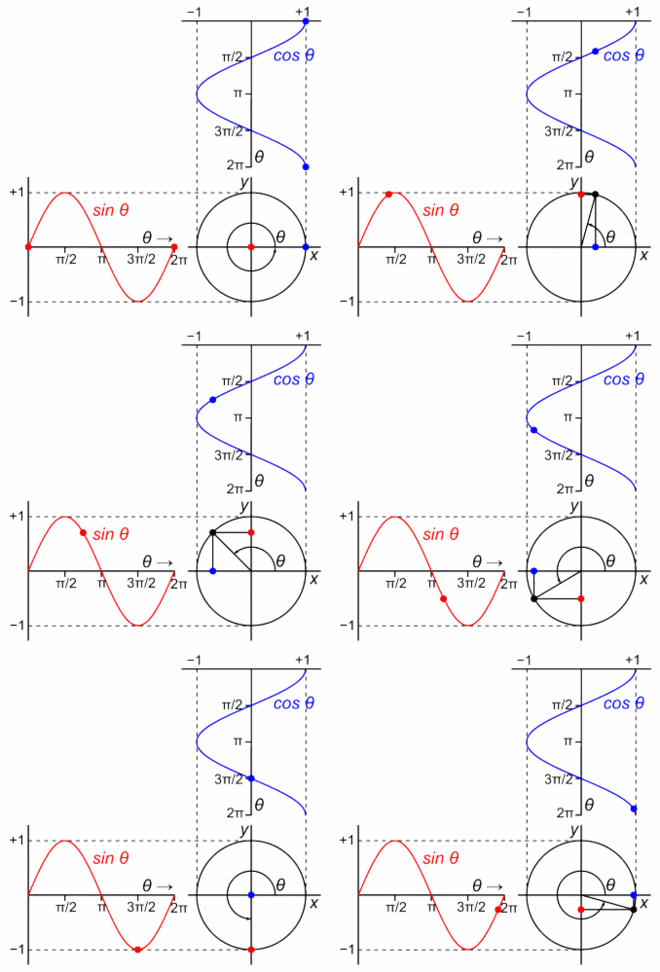
Euler’s Formula: the motion of thought around a circle.
It’s deceptively simple, but its implications are staggering. At its core, it shows that circular motion—like a point rotating around a unit circle, or the perpetual motion of an eternal mind—necessarily produces sine and cosine waves. One represents motion on the x-axis (cosine), the other on the y-axis (sine). These are orthogonal—at right angles to each other. This isn’t just mathematical elegance; it’s the blueprint of light itself.