Why Governments Aren’t Startups and Souls Aren’t Employees (Part 1)
This weekend, I had the pleasure of watching the San Francisco Mime Troupe perform in the sunny Dolores Park. I’ve seen them before, but I’d forgotten how radical, witty, and intelligently provocative their work is! Their latest show offered a biting local satire of the city’s—and country’s—dysfunction, set to live music, brilliant sound effects, and delivered with the kind of fearless theatricality that only radical artists can pull off. One line stood out and lodged itself in my mind: “The government is a business, not a service for the people.”
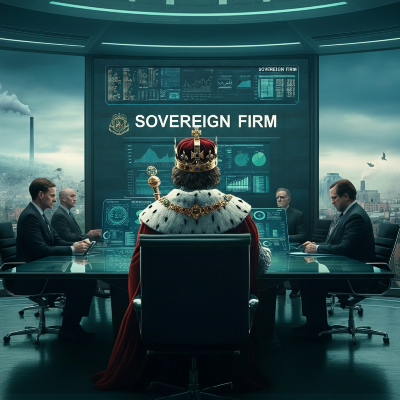
It was meant to be satirical, of course—but satire only works when it exaggerates something real. And what’s striking is just how unexaggerated that line feels these days. The idea that government should be operated like a business has been slowly ossifying from cliché into philosophy. You can hear it almost everywhere now—among tech elites, in startup rhetoric, and across various flavors of libertarian and accelerationist thought. But it finds its strongest foothold in a movement called the Dark Enlightenment: a loosely connected network of anti-democratic thinkers shaped by Curtis Yarvin and echoed by voices like Peter Thiel.
The Business-State Delusion
Yarvin, for instance, doesn’t just think government should be efficient. He thinks it should literally be run as a firm. In a recent essay, “A New Sovereign Accounting,” he wrote, “The state is a firm. The nation is its property.” He goes further, suggesting that fiat currency is government equity—shares in the state, devoid of rights but backed by force. He proposes a world where governance is stripped of its moral and philosophical heritage and reimagined purely through the lens of control, ownership, and capital efficiency. The logic of corporate structure is transposed wholesale onto the structure of civilization.
And while that may seem like a clever provocation, or a coldly rational alternative to the perceived chaos of modern democracy, it is—in the end—a category error. It is a fundamental misunderstanding of what government is for, what people are, and what the arc of human development actually demands from us.
Because a country is not a company. A state is not a product. And the soulis not a business asset.
The real cost of this worldview isn’t just political or economic—it’s existential. It leaves out the very thing that makes us human: the mind behind the metrics, the self behind the system. It severs purpose from power, depth from data. It forgets the soul.
Please note that this content is free, and only requires a free subscription to view.