Maybe We Are All Theys
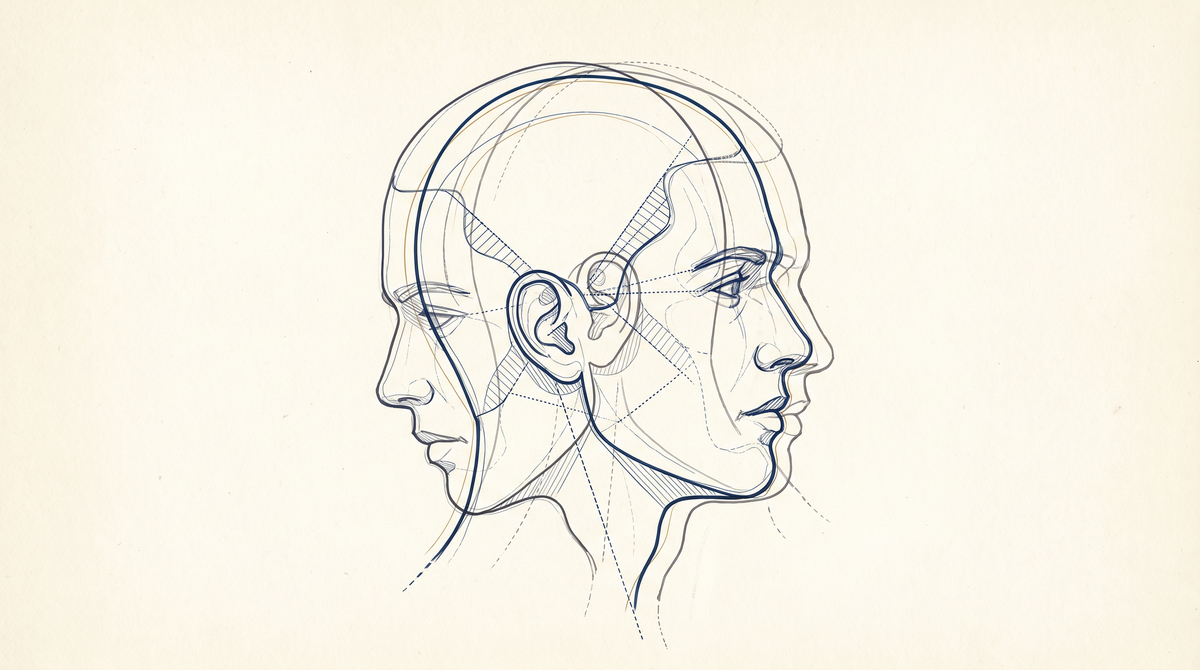
There’s a moment most of us have lived but never quite admitted out loud.
It’s late. You’re tired. You’re typing a message you wouldn’t send in daylight, or eating the food you’d promised yourself you wouldn’t, or saying the thing to your mother you’d resolved a hundred times not to say. And somewhere in the middle of it, there’s a small, clear voice—not loud, not dramatic, just present—that says: I am watching this happen, and I do not endorse it.
Then morning comes. You read the message. You replay the conversation. The voice that’s appalled is somehow the same voice that pressed send.
We have a phrase for this. I wasn’t myself last night.
Have you ever paused on what that sentence actually says? Wasn’t myself. So who, exactly, was I? You have one name. You have one face. And by your own admission, several different people have been wearing them.
We file this under moodiness. We file it under complexity. We tell ourselves it’s nothing structural—certainly nothing like those people, the ones whose plurality got loud enough to earn a label. Theirs is pathology. Ours is just personality.
But we know. On some level we know. The civil war inside us is real. The frame we’ve been given for it doesn’t fit.
The Word for It
The clinical word for inner plurality is dissociation. We use it two ways.
We use it casually—I dissociated during the meeting—meaning we drifted, lost contact with the moment. And we use it diagnostically: dissociative identity disorder, the loud version, with names and switches and time gaps. Both uses share an assumption. Dissociation is a failure. Something went wrong. Unity was the natural state, and dissociation is what happens when that unity breaks down.
The careful clinical literature tells a different story.
The brains and inner lives of people diagnosed with DID appear, structurally, like more pronounced versions of what every brain is doing. Deeper partitions. Harder transitions. Weaker communication between coalitions. But the architecture—coalitions of coordination, taking turns, holding different memories, different competencies, different stances toward the world—that architecture doesn’t appear to be unique to them.
It’s the architecture of being a person.
Trauma doesn’t create the partitions. It sharpens them. So does stress. So does years inside a role you can’t leave. Most of us are doing it, quietly, all the time. The difference between the diagnosis and ordinary life isn’t whether you’re partitioned. It’s how loud your partitions have become.
What looks like pathology is the loud version of how every mind is built.
Maybe We Are All Theys
This is where the thing gets interesting. Because once you accept it about yourself, you can’t un-see it about anyone else.
Your partner who said the cruel thing isn’t a cruel person. Your partner is a coalition that, in that moment, was being run by a member who says cruel things—and other members who are quietly horrified, who will surface tomorrow, who will be the one who apologizes.
The friend who keeps making the same self-destructive choice isn’t a self-destructive friend. They’re a coalition where one member keeps winning the internal vote.
The estranged family member. The boss who can’t hear you. The politician you cannot fathom.
Every person you’ve ever been in conflict with is a we. Every fight you’ve ever been in is coalition-against-coalition, mediated through faces and names that make it look like person-against-person.
We’ve been arguing with the wrong unit of analysis our whole lives.
Hold that for a second. Don’t move past it. The civil wars inside you—the ones you’ve been treating as moral failings, as proof you’re not as evolved as you should be by now—those aren’t moral failings. They’re coordination problems. You are a we. And the wars between people you love, the ones that always seem to be about the dishes or the calendar or the tone of a single sentence, those are coalition collisions. Most of the membership invisible. Most of the negotiation conducted underground.
Maybe we are all theys.
The Council Has Always Been There
The mind at rest doesn’t run a single program. It cycles. Coalitions of regions come together, hold for seconds, dissolve, give way to other coalitions. Each handles different work—relationship, narrative, the body’s report, the part that runs the day. They cycle. They don’t merge.
We can see this dynamic in the brain itself, and should it really be a surprise? Mind and brain work by the same organizing principles. The architecture that shows up in the data is the architecture clinicians have been describing from the inside for a century.
In a flexible mind, the cycling is fluid. Information passes across the handoffs. One part of you knows what the other parts have been up to. Under stress, the transitions get sticky. Under trauma, the partitions harden. In DID, the partitions become walls.
Todo: But the architecture appears to be the same in all of them.
We are councils. We have always been councils. The unity we feel is something we keep achieving, breath by breath, against the natural plurality of the system that we are.
And Then You Look Around
The unity you feel isn’t a starting condition. It’s a coordination achievement, renewed moment by moment, more fragile than it advertises. The work of becoming whole was never about silencing the council. It’s about letting the members hear each other—widening the bandwidth between parts of yourself that have been operating in separate rooms for years.
Now hold that thought and look up.
The depression and anxiety we treat as private illnesses are, structurally, what happens when the bridges between your inner coalitions stop carrying weight. Hope can’t reach the part that acts. Vigilance can’t reach the part that decides what’s safe. The system carries on, but it carries on partitioned, and the symptoms are what partition feels like from the inside.
Scale that out.
We are also a coalition. A vast, distributed we made of all the smaller we’s. And the symptoms we keep treating as a public crisis—the polarization, the cynicism, the feeling that the country is becoming a stranger to itself—have the same shape. The same architecture, one level up. Bridges between us, narrower than they used to be. Coalitions that can no longer reach each other. Hope on one side of a partition. Action on the other.
This is why personal coherence and collective coherence aren’t separate projects. They’re the same project, viewed from different distances. The civil war inside is the civil war outside, played out in a smaller theater first.
Maybe we are all theys.
And once you can see that, the world doesn’t look the same.



Comments ()