We Built This City
Quick note: one of my favorite creative exercises is to let myself get drawn to a song—not one I've decided is good, just one that makes me FEEL something. I know it when I feel it. Then I sit, and I write, and I write, and I see what comes out. This is one of those.
Notice how rarely anyone says we anymore without irony.
We have me. My brand. My niche. My feed. My truth. The word we has been quietly evacuated from public life. When a politician uses it, you assume manipulation. When a CEO uses it, you assume marketing. When a stranger uses it, you flinch. The default unit of contemporary life is the atomized self, broadcasting from a personalized feed no one else is watching, in conversation with a we that no longer assembles.
We Built This City gets called the worst song ever recorded. Blender named it in 2004. Rolling Stone's readers seconded it. Grace Slick, who sang it, agrees. The complaint is always the same: corporate cynicism dressed as rebellion.
Fair enough. But it makes me feel something. Not nostalgia, and not the kind of thing you'd defend in an argument—something I couldn't put my finger on at first. I had to sit with it before I understood: part of what gets mocked as corniness is actually the sincerity of the we—a word the song uses without flinching, in a way the culture has lost the ability to do.
So I'm riffing here. Listening hard to a song nobody takes seriously.
We built this city. We built this city on rock and roll.
Not I. Not they. We. And the we keeps scaling.
The We Inside
Start where you actually live: inside your own head.
You already know you're not one voice. There's the part that narrates—sequences, explains, defends. And there's the other part, harder to name, that notices what the narrator misses. The slant of light. The wrongness you sense before you can say what's wrong. The stranger who is somehow already familiar. Call it the smaller and larger parts of yourself, the loud part and the quiet part, whatever your own experience has taught you to call it. The point is structural, not anatomical: a mind is a we before it's anything else.
Most of us spend our days hearing only one of those voices. The narrator wins because the narrator is loud. The other gets routed around. We call this being focused. Sometimes it is. Sometimes it's just half a person walking around insisting it's whole.
And the quiet part isn't quiet because it has nothing to say. It just doesn't speak in words. It grasps the whole shape before the narrator can lay it out in a line. Muteness in one language isn't muteness. It's the wrong demand.
Coherence, at this scale, is the moment the parts start listening to each other again. Not merging. Listening.
You are already a we. You've been one your whole life.
The We That Keeps Recognizing Itself
There's another kind of we that doesn't depend on shared geography or shared century. You meet someone and the recognition arrives before the introduction. You read a sentence written four hundred years ago and feel directly addressed. Other people—scattered across time, across language—have been working on your exact questions, leaving notes for whoever would find them.
Say you don't know me, or recognize my face.
The faces change. That's the trick of it. The lineage isn't a club with a roster. It's more like a river—same river, different water, continuous across centuries though no single drop persists. You belong to it the way a note belongs to a chord. Not by signing up. By resonating.
I finished a book before I knew his name, and then read a man who'd spent fifty years saying, carefully, in the language of systems and physics, that we are connected to everything—that the whole thing coheres. I'd come to it from the inside, by another road. He'd been in the river the whole time. That's how it works. You don't inherit the others. You recognize them.
You belong to a we you never signed up for. You've been finding the others your whole life.
Built on Rock and Roll
We built this city on rock and roll.
This is where the song stops being modest.
The claim isn't that civilization rests on capital, or conquest, or technology. It rests on expression that found its form. And not just any expression—rock and roll specifically, which is worth pausing on.
Because rock and roll is a smuggling operation. It always was. Born from the blues, gospel, work songs—Black American traditions that carried philosophical and emotional truths the mainstream couldn't hear directly, so they came in through the body. Through rhythm. Through a backbeat you couldn't argue with. The message rode in on a vehicle white audiences thought was just dancing.
Every serious cultural shift in this country has moved that way. The civil rights movement had its songs. So did labor. The argument lost in committee; the song won the room.
The city—any city worth building—rises on that. Not on the contracts. On what the workers were humming while they laid the stones.
Marconi Plays the Mamba
The line everyone calls nonsense is the hinge of the whole song.
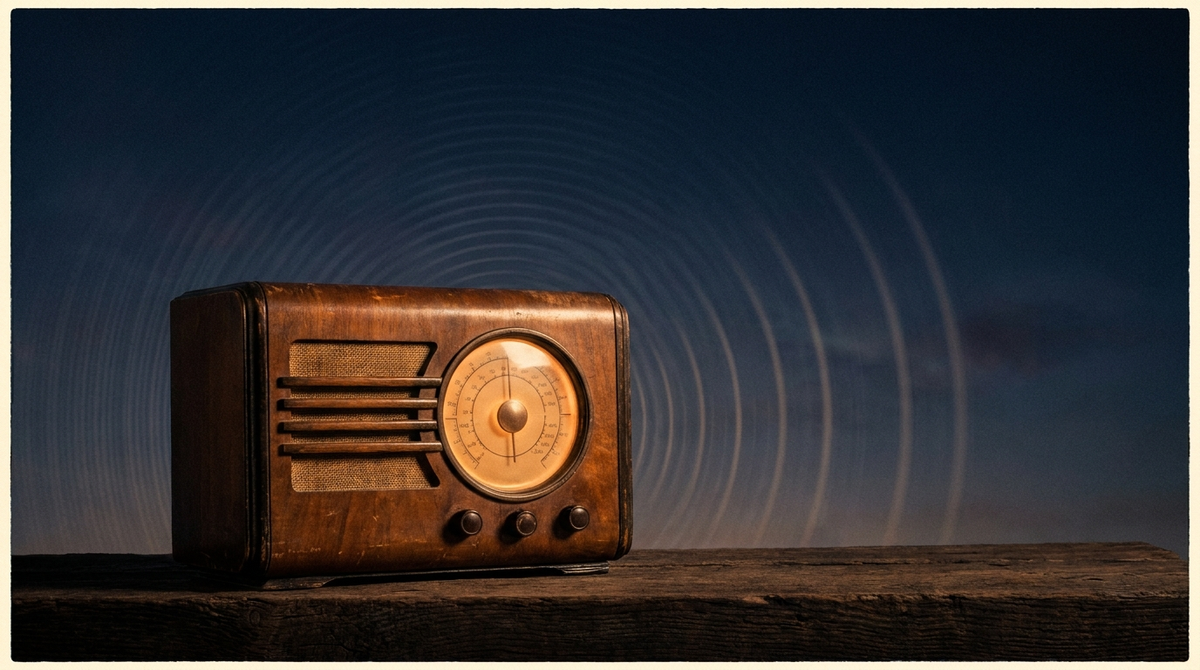
Marconi plays the mamba, listen to the radio. Don't you remember?
Marconi made the invisible transmissible. He proved—with hardware, in public, repeatably—that a signal could move through what looked like empty space and arrive intact in a receiver tuned to catch it. No wires. No physical contact. Just structure, propagation, and a listener who knew the frequency.
That isn't a metaphor for the inner life. It's a demonstration that the inner life has always worked this way.
The mamba is a rhythm. Someone, very long ago, set a rhythm going. Maybe it was a stretched string and a ratio. The point is that once it sounded, it never stopped. It's still propagating. You're picking it up right now, reading this, and the only reason any of this lands is that part of you was already tuned to it before you started.
Don't you remember?
Plato had a word for this. Anamnesis. Recollection. The idea that learning, at its deepest, is not acquisition but remembering. The signal was already in you. The transmission only helped you notice.
This is what the best art is doing. Not trying to convince you of something new. Reminding you of something you already are.
Looking for America
There's a verse people skate right past.
Looking for America, coming through your schools.
Look for it, not come to it. The difference is everything. You don't come to a place that already exists on a map. You look for one that exists first as a shape—a possibility, a thing you'd know the instant you found it, because some part of you was already holding the template. Plato again. The better world isn't built and then arrived at. It's looked for. Remembered forward. Recognized into being.
I don't mean the country. I mean America the way the song half-means it: the name we give the place that doesn't exist yet but presses on us as if it should. The form of the thing we keep almost building. You don't build it from scratch. You recognize it—and every generation goes looking, and most don't find it, and the looking is itself the thing that gets passed on.
And notice where the song says it comes through. Not through the markets. Not through the statehouse. Through your schools. Through the children.
Coming Through Your Schools
If the signal is real—if there's a frequency you can catch or miss—then the moment that matters most is early. Before the receiver gets jammed.
A child is the most open instrument there is. Still tuning. Still finding which station is theirs. And what we mostly do, without meaning to, is let the noise win. The distortions set. They harden. And then we rename them: the anxious loop becomes just how I am. The shut door becomes my temperament. The static gets mistaken for the self.
It doesn't have to go that way. Coherence—the thing this whole song keeps circling—isn't a mood or a virtue. It's a structure. Parts holding together, in rhythm, each distinct but in phase. And structure can be seen. It can be shown to the person living inside it, early enough to matter.
What if every child had a way to see their own mind? Not measured against some norm, not ranked against the kid next to them—a mirror to their own signal, nothing else. Not to fix them. Children aren't broken. So they could know themselves early enough to stay free—catch the static while it's still static, before it gets a name and a backstory and a permanent room in the house.
Knowing your own mind isn't a luxury. It might be the most basic right there is. And we hand it out last, if at all—usually after the damage has already chosen a personality.
That's what coming through your schools could mean. Not a curriculum. A frequency, reaching the receivers while they're still open.
The Choke Hold
But the remembering is hard, and there is a reason.
It's just another Sunday, in a tired old street. Police have got the choke hold, and we just lost the beat.
Authoritarian systems can survive a lot of dissent. What they can't survive is rhythm. A people in sync with themselves is ungovernable in the old sense—not because they're armed, but because they're coordinated. That's why regimes ban specific music before they ban specific speech. Why every serious clampdown goes after the gathering places first—the union halls, the dance floors, the churches. The state can argue with words. It can't argue with a room of people breathing in time.
So the choke hold is rhythmic before it's physical. Disrupt the beat. Scatter the signal. Keep people out of sync with themselves and with each other, and you don't need overt force. You've already won.
Just another Sunday, in a tired old street.
That's the picture of a population whose beat has been broken. The opposite of coherence isn't chaos. It's deadness. The street isn't tired because it's old. It's tired because the music stopped.
Wrecking Ball Into the Guitars
Who counts the money underneath the bar? Who rides the wrecking ball into our rock guitars?
The guitars are transmitters. They're how the signal gets out. So the wrecking ball isn't only censorship—it's the systematic destruction of the means of transmission. Art schools defunded. Public squares privatized. Local scenes hollowed out.
The wrecking ball doesn't need to silence the message if it can break the instruments.
But guitars are cheap. That's the thing. The signal finds new vehicles. It always has. Cathedral, monochord, dialogue, novel, pop song, essay, whatever comes next. The medium gets compressed and the message gets through anyway, because the message was never the medium.
The vehicles are disposable. The signal is older than any of them.
We Built This City
So the chorus, heard again, lands differently.
We built this city. We built this city on rock and roll.
The we is the constant. The voices inside one person learning to sing in unison. The strangers who recognize each other across a century. The rock and roll—the smuggled truth that got past the gatekeeper—is the constant. The transmission is the constant. The forgetting is constant too, but so is the remembering.
The chorus is offering us a frequency.
We can tune to it or not. That's the whole game. And the ones still most able to hear it are the ones we haven't taught to stop listening yet. The looking comes through the schools because that's where the receivers are still open. If we ever wanted to build the city—the real one, the one we keep looking for—that's where we'd start.

Comments ()